
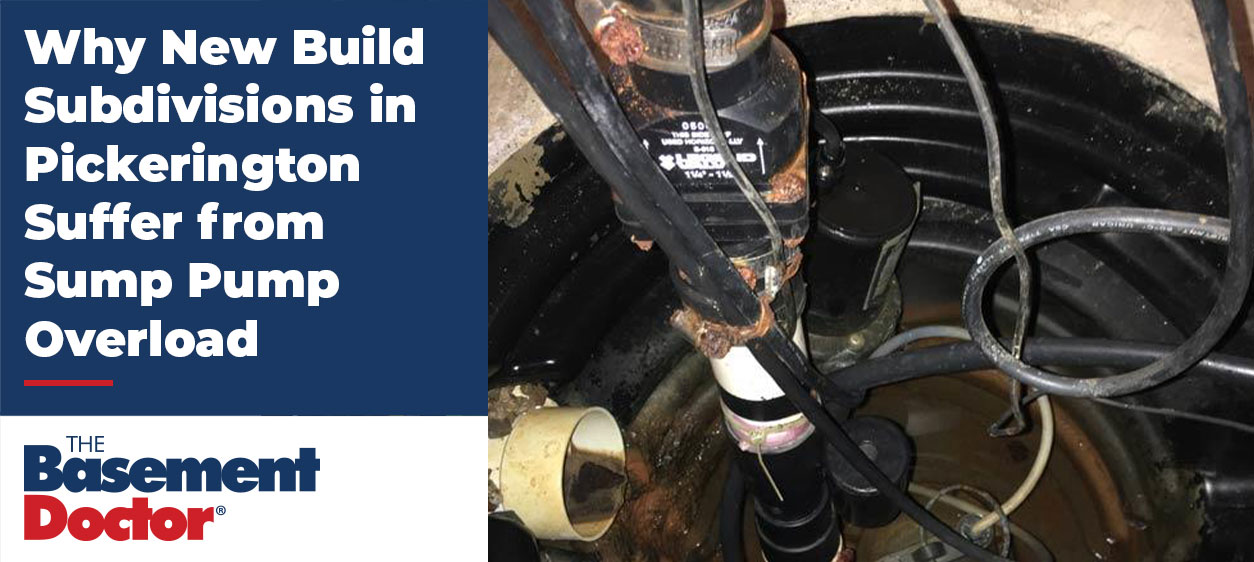
A brand-new basement is not the same as a protected basement. That’s a distinction Pickerington homeowners in new subdivisions learn the hard way when a single sump pump fails during a heavy spring storm — flooding a finished basement with thousands of gallons of water in under three hours.
New construction creates a false sense of security. Builder-grade sump pumps installed in Fairfield County homes are often undersized for the clay soil conditions surrounding new foundations. Clay soil holds water instead of draining it, pushing that water pressure directly against your foundation walls. Add in the fact that most residential sump pumps last only 7 to 10 years, and new construction sump pump problems can surface well before homeowners expect them.
Your home is one of your biggest investments. Understanding why new subdivision basement flooding happens — and what to do about it — is the first step toward protecting it.
Quick Answer: Why New Pickerington Homes Can Overload a Sump Pump
Sump pump overload is not a mystery. Water arrives in the pit faster than the pump can push it out — that’s the whole problem.
What overload means: Water enters faster than the pump removes it
A pump running non-stop isn’t necessarily broken. If the pit level keeps rising while the discharge flows cleanly outside, the pump is simply outpaced. Prolonged heavy rain, fast snowmelt, or a rising water table can push inflow past what a single pump was built to handle. That gap between inflow and output is what drives new construction sump pump problems across Pickerington subdivisions.
Fairfield County clay soil and pressure against foundations
Clay soil saturates slowly and drains even slower. As it fills with water, it pushes that pressure directly against new foundation walls. Waterproofing guidance accounts for this by sizing system capacity at roughly 8 gallons per minute per 1,000 square feet on clay soil — compared to 14 gpm on sandy soil. That calculation only holds when the installed pump actually matches site conditions rather than a generic builder spec.
How subdivision grading and stormwater runoff affect water flow
Code requires the ground next to a foundation to drop at least 6 inches within the first 10 feet, directing water away from the house. In a new subdivision, that slope depends on coordination between the excavation crew’s rough grade and the landscaper’s finish grade. Gaps between the two let stormwater runoff work its way back toward the foundation instead of away from it.
How settling backfill can change drainage around a new foundation
Backfill around a new foundation doesn’t stay put. It continues to shift and settle over the first several months. Concrete needs roughly 28 days to cure, and backfill packed against a wall too soon — or filled with heavy clay instead of granular material — traps water against the foundation rather than guiding it toward the drain tile.
Why builder-grade pump capacity may not match peak water flow
Proper pump sizing means matching gallons-per-minute output, at the actual lift height, to peak inflow — with a safety margin of 1.5 times that measured peak. A 1/3 hp pump, the standard default for average conditions, delivers significantly less capacity than a 1/2 or 3/4 hp unit built for deeper basements or high water tables. Builder-grade installs rarely go beyond that baseline, leaving little room when conditions push past average.
Why code compliance does not guarantee protection in every storm
Meeting code is not the same as being protected. Drainage codes are built around a defined storm event, not the worst one on record. Public sump standards size pumps using a 50-year design storm frequency with a 1.25 safety factor, and municipal retention rules typically size storage for a 10-year, 24-hour event. A storm beyond that threshold can overwhelm even a correctly installed system. Code tells you the minimum — it doesn’t promise you’ll stay dry.
Signs Your New Home’s Sump Pump Needs Attention
Catching a drainage problem early keeps it from becoming a flooded basement. After every storm, these are the signs worth checking in a Pickerington new build.
Constant Running After Rain Versus Frequent Short Cycling
A healthy pump cycles every 10 to 30 minutes during a typical storm and every 5 to 15 minutes in severe weather, slowing as rain lets up. Short cycling — pump starts of 5 to 10 seconds that repeat within a minute — strains the motor beyond its rated 4 to 10 starts per hour and points to an undersized basin or a float switch set wrong. If cycling continues well after rain stops with no clear reason, the pit is likely refilling from its own discharge line rather than fresh inflow.
Water Pooling Near the Basin While the Pump Runs
A few inches of standing water in the pit is normal — it helps lubricate the pump and seat the float switch. Water that stays consistently high while the pump runs points to a blocked discharge pipe, a failed check valve, or a pump too small for the volume reaching it. A bone-dry pit during heavy rain is just as telling, often meaning water never reaches the drainage system at all.
Grinding Sounds or Signs of Overheating
Hearing a grinding noise from your pump? That usually means debris in the impeller or a motor on its way out. A burning smell or a hot pump housing signals the motor is overworking itself — often because it’s fighting more water than it was built to move.
Musty Smells and Moisture in New Construction
Up to fifty percent of the air on your first floor pulls from directly below the house. A musty odor that gets worse after storms traces back to poor grading, short downspouts, or water seeping through foundation cracks and gaps. In a new build, don’t dismiss this as normal — it’s worth investigating.
A Silent Pump During Rising Water
Before assuming the pump itself failed, check whether the whole property has lost power. A power-loss alert means the circuit is down and the pump cannot run at all. A high-water alert, on the other hand, means water is rising despite power being present — often from a clogged intake or a stuck float. Both situations need attention before the next storm arrives.
What a Properly Sized Sump Pump System Needs
Worried your new home’s sump pump isn’t up to the job? The answer starts below the slab. A reliable sump pump system in Pickerington matches its capacity to actual site conditions — not a builder’s default spec.
Primary pump capacity matched to water inflow and discharge height
Sizing a pump correctly means calculating peak inflow, then multiplying that figure by a 1.5x safety margin. From there, that number gets checked against total dynamic head — the vertical lift combined with friction loss through the discharge pipe and fittings. A 1/3 hp pump handles 7 to 10 feet of lift adequately in average conditions. A 1/2 hp unit moves 35 to 40 percent more water across higher lifts. Homes with deeper basements or elevated water tables often need a 3/4 to 1 hp pump to keep pace with actual inflow. Builder-grade installs rarely go past the minimum. That gap is where problems start.
Foundation drain tile capacity and a clear discharge route
The pump is only as effective as the system feeding it. Drain tile must carry water to the pit without restriction. Discharge lines need to be sized to pump capacity — never smaller than 1-1/4 inch pipe — and a check valve is required to stop water from flowing back into the pit once the pump shuts off. A clogged or undersized discharge route puts the same strain on a good pump as an undersized one.
A battery backup sump pump: Protection limits and the single-pump risk
A backup battery protects against power loss. It does not protect against pump failure. That distinction matters. If the primary pump fails during a storm, a battery backup running the same failed pump does nothing. Backup pumps should match or exceed the primary pump’s output so the system holds when it’s needed most. A single pump with no redundancy is a single point of failure — something worth addressing before storm season, not during it.
Safe testing before storm season and sump pump annual maintenance
Routine sump pump annual maintenance, completed before storm season begins, confirms the system still performs as originally installed. Our team can walk through that process with you, check the float switch, test the discharge line, and verify backup power is ready. You can count on us to catch what’s easy to miss before it becomes a flooded basement.
Local Examples and Next Steps for Pickerington Homeowners
Pickerington homeowners don’t have to guess at any of this. We’ve seen these problems firsthand in local homes, and we know exactly what causes sump pump overload in new builds — and what fixes it.
Ask Your Builder for Pump Specifications, Drainage Plans, and Code Records
Start with the paperwork. Ask your builder for the pump’s gallons-per-hour rating, the drainage plan, and the code edition the home was permitted under. Builder-grade installs often meet the minimum, not the maximum. That documentation tells you precisely what you’re working with before assuming anything needs to change.
When to Replace a Sump Pump Instead of Repairing or Adjusting
Most pumps last 7 to 10 years. If your pump is approaching that range, proactive replacement makes more sense than waiting for a failure during a storm. Age alone is enough reason to act, even when the unit still runs.
Real Pickerington Homeowners, Real Results
Paul, a Pickerington homeowner, called us after noticing stair-step wall cracks and a sump pump that wouldn’t stop running. Our team installed a force beam and a new sump pump with a freeze guard on the discharge line. A related project at the same home traced continuous pump operation to a stuck switch — resolved with a new pump and freeze relief protection.
These aren’t edge cases. They’re the kind of problems we find regularly in new Pickerington subdivisions.
Choose the Right Backup Before Storm Season
Before buying a backup system, confirm your battery is deep-cycle rated and sized for your pump’s draw. A backup that can’t match your primary pump’s output offers little real protection when you need it most.
Schedule a Site Assessment — Don’t Go It Alone
Never reach into a sump pit near a running pump. If something seems off after a storm, the right move is to schedule a site visit with our team. We’ll take care of the inspection so you don’t have to guess.
Conclusion
Sump pump overload in Pickerington rarely comes down to one defective part. Clay soil, settling backfill, and builder-grade pump capacity all push water toward the same foundation — and toward the same undersized pump. When those conditions line up, it’s not a question of whether overload happens. It’s a question of when.
We’ve seen this pattern firsthand in Pickerington homes, and we know what fixes it. A properly sized sump pump system, paired with a battery backup, protects your basement long after the builder’s warranty expires. You can count on us to assess what’s actually in place, identify where the system falls short, and deliver a lasting solution — not just a temporary fix. Contact The Basement Doctor today to schedule your sump pump system estimate.