
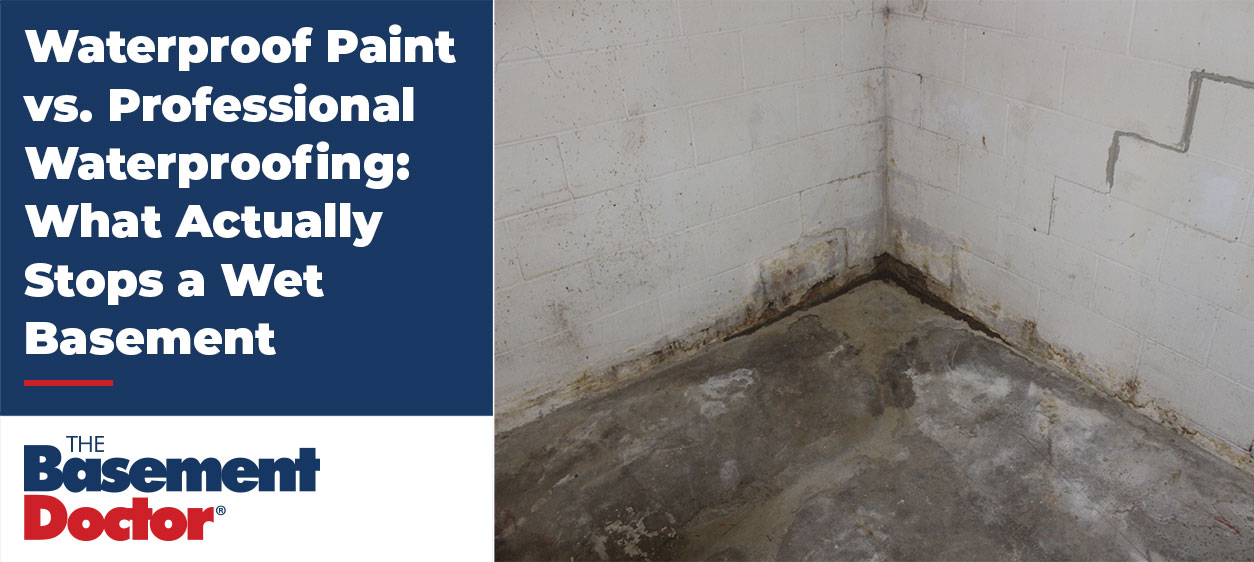
Damp basement walls. It’s one of the most common concerns we hear from Central Ohio homeowners — and one of the most misunderstood. Waterproofing paint can withstand only about 12 pounds of pressure per square inch, yet saturated soil can push against your foundation with thousands of pounds of force. That gap is exactly why a freshly painted basement wall can still end up wet.
At The Basement Doctor, we have worked with homeowners from Powell to Athens who tried a coat of waterproof sealer first. Peeling paint, mineral-stained walls, and that stubborn musty smell told us the same story every time — the paint wasn’t the problem. The water pressure behind the wall was.
This guide covers when a waterproof sealer genuinely helps, when it falls short, and why professional basement waterproofing in Columbus, Ohio is the solution that actually lasts.
Does Waterproof Paint Work on Basement Walls?
Waterproofing paint soaks into the pores of concrete or block, then cures into a film that bridges small openings where moisture vapor passes through. Well-rated products like DRYLOK test against ASTM standards and can resist roughly 15 PSI — the equivalent of holding back a 33-foot column of water. That number sounds solid until you consider what’s sitting on the other side of your basement wall after a wet Ohio spring.
So where does a waterproof sealer actually help?
On walls with light dampness, concrete dust, or a faint layer of efflorescence, a quality sealer does a reasonable job. It’s also a budget-friendly starting point, running roughly $1 to $6 per square foot installed. What it won’t do is fix the reason your basement feels humid. Condensation happens when warm, moist air hits a cool concrete wall — and painting over that wall doesn’t change the humidity in the room. A dehumidifier or better ventilation addresses the cause. The coating just handles what shows up on the surface afterward.
Bubbling and peeling paint are warning signs, not cosmetic issues. Water is pushing through the concrete from behind, working against the coating even though the surface looks finished. That failure pattern usually starts with minor blisters, then progresses to full peeling — often within a year or two of application. Peeling that concentrates near the floor typically points to pressure-driven water moving through the lower wall and the floor-wall joint.
Still weighing whether painting makes sense for your situation? Our post on can you paint concrete basement walls walks through prep steps and product choices in more detail.
Here’s how paint and professional interior waterproofing compare:
| Factor | Waterproof Paint | Professional Interior Waterproofing |
| Purpose | Surface barrier for light dampness | Manages and redirects water at the source |
| Lifespan | Often 1 to 3 years before failure on a leaking wall | Built to last for decades with upkeep |
| Pressure control | Rated near 15 PSI at best | Handles water regardless of soil pressure |
| Warranty | Covers the product, not a dry basement | Documented system warranty on performance |
| Relative cost | Roughly $150 to $400 DIY | $3,000 to $8,000 for a full system |
| Failure risk | Blisters, peels, traps moisture behind the film | Low when the system is designed correctly |
That gap in the table is exactly why a damp basement in Reynoldsburg or Grove City keeps returning after a fresh coat of paint.
Why Paint Can’t Beat Hydrostatic Pressure in Central Ohio
Water pressure, not surface moisture, is what actually damages Ohio basement walls. Central Ohio’s clay-heavy soil traps groundwater against your foundation instead of letting it drain away. Swelling clay can push roughly 5,000 pounds per square foot of force against those walls. That pressure finds its way through hairline cracks, porous concrete block, and the cove joint where your floor meets the wall — and since clay draws moisture upward through capillary action as far as 12 to 20 feet, the lower third of your wall takes the worst of it. Waterproofing paint, rated near 15 PSI, was never built to handle a load like that.
The warning signs are usually easy to spot. Puddles after a storm, a musty smell that lingers for days, and white efflorescence crusting the lower wall all point to the same thing — water is working its way through, leaving mineral salts behind as it evaporates.
Not sure whether you’re dealing with condensation or an active leak? The 24-48-hour foil test gives you a clear answer. Tape a sealed square of foil directly to the wall and leave it for two days. Dampness on the room side means condensation; dampness on the wall side means water is pushing through the concrete itself. That one simple test tells you whether paint might help or whether you need a drainage solution.
Columbus gets more than 40 inches of rain each year, and every winter’s freeze-thaw cycle expands trapped water by roughly 9%, widening cracks season after season. Spring rain and snowmelt push that clay even further. If your yard stays soggy for days after a storm, check the signs of a high water table — your basement walls are likely feeling it too.
We see this same pattern throughout the region. Water seepage in Grandview basements, sump pump overload in newer Pickerington subdivisions, clay-soil pressure in Powell, Delaware, and Athens — it’s the same underlying problem every time.
Concerned about what’s happening behind your basement walls? Book a free basement inspection with our team, whether your home is in the Columbus service area or a surrounding community. We’ll give you a straight answer.
What Professional Interior Basement Waterproofing Includes
Professional interior basement waterproofing doesn’t just cover the problem — it solves it. Here’s what a properly designed system actually includes.
Interior drainage and sump pumps form the foundation of the plan. A drain tile system collects water near the footing, channels it along the perimeter, and a sump pump discharges it safely outside your home before it ever reaches the floor. Water gets managed at the source, not masked at the surface.
Crack sealing and wall vapor barriers come next. A high-viscosity polyurethane polymer seals wall cracks deep enough to stop 95% of water even if the primary seal is ever compromised. Any residual moisture gets routed through a secondary drainage layer directly into the sump system. Vapor barriers are installed only after active water sources are addressed — placing a barrier over a wall that’s still seeping traps moisture behind it and creates the right conditions for mold.
Why The Basement Doctor works from inside: interior systems skip the excavation, disrupted landscaping, and multi-day project timelines that come with digging around a foundation. Exterior membranes have their place during new construction or when a foundation is already excavated for other repairs, but retrofitting one into a finished yard is a far bigger undertaking than most Ohio homeowners want to take on.
Grading, gutters, and downspouts are your first and most affordable line of defense. Clean gutters, downspouts extended 4 to 6 feet from the house, and soil sloped away from the foundation all reduce the water load before it reaches your walls.
Dehumidification and mold prevention handle the humidity that remains once active leaks are controlled, protecting your belongings, framing, and air quality. Pair that with annual maintenance on the sump pump and your system stays ready for whatever the next storm brings.
Before hiring anyone, ask for the system design, discharge plan, maintenance terms, and a written warranty covering both labor and materials. A reputable basement waterproofing Columbus, Ohio team explains every step before the work begins. You should never feel pressured — just informed.
When Paint Is Enough and When to Call a Professional
Here’s a straightforward way to think about it. Minor surface dampness, a little concrete dust, or faint mineral deposits after one heavy rain? A waterproof sealer can help. Recurring puddles, a coating that’s already blistering, or mineral deposits that keep coming back? That’s a drainage problem, and paint won’t fix it.
Waiting rarely saves money. Untreated moisture risks mold, damaged belongings, and can progress toward cracking or bowing walls as pressure builds against the foundation. Water and structural problems are often connected. One free inspection checks both at once.
Common questions we hear:
Does waterproof paint really work? It helps with minor moisture but won’t address the root cause of water intrusion — making it a temporary fix, not a long-term solution. Coatings like DRYLOK carry warranties up to 15 years, but those warranties cover the product, not a guaranteed dry basement. Also worth knowing: efflorescence must be fully removed before paint goes on, since sealant only bonds to bare masonry.
What does interior waterproofing actually involve? Drainage, sump pumps, and crack sealants work together to manage water at the source — and most of it installs without major excavation.
What does it cost, and will a dehumidifier help? Costs scale with wall length and drainage needs. A dehumidifier reduces humidity but won’t stop water entering through cracks or leaks. It works alongside a waterproofing system, not instead of one.
Conclusion
A fresh coat of waterproof paint has its place — but it was never built to handle the kind of pressure Central Ohio soil puts on a foundation. When a damp basement keeps returning after every repaint, that’s the wall telling you something paint alone can’t fix.
Your home is one of your biggest investments. We understand that quality matters, and a dry, healthy basement shouldn’t be something you’re revisiting every couple of years. That’s why we recommend permanent, reliable solutions — the kind Columbus, Ohio homeowners can count on for decades.
Ready to find out what’s actually going on behind your walls? Book a free basement inspection, ask our team about financing options, or take a few minutes to read what your neighbors across Central Ohio have said about their experience with The Basement Doctor. We’re here whenever you’re ready.