
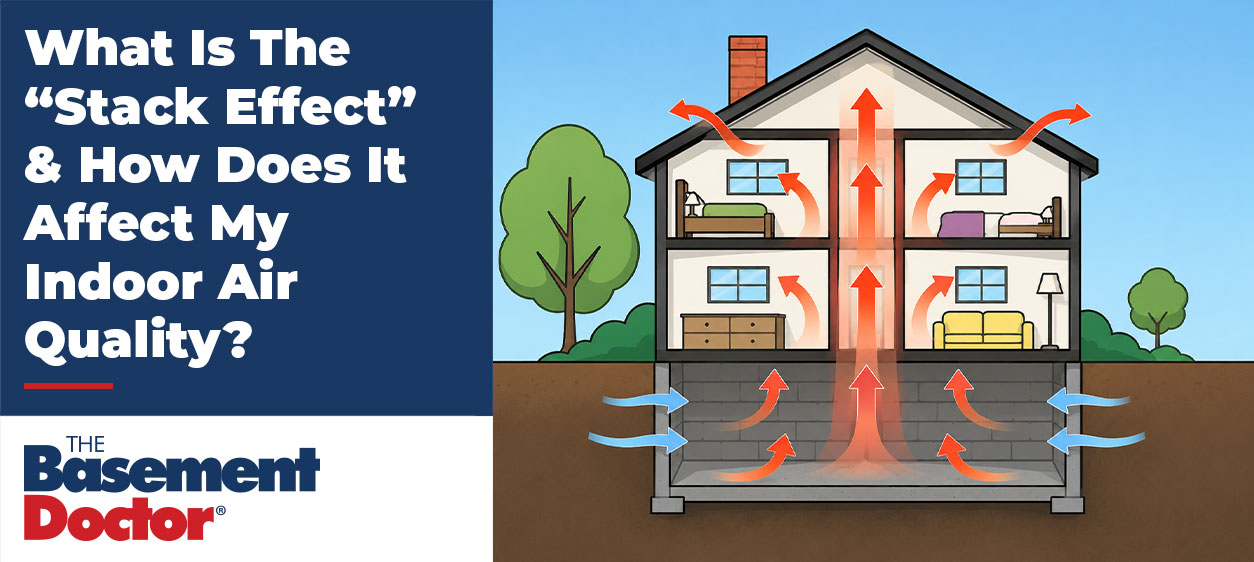
The lowest parts of a house do far more than support the structure. In a cold season, the basement or crawlspace often becomes the primary intake point for the entire home’s air movement. As warm indoor air rises and leaks out through upper levels, replacement air is pulled in from the foundation line. In a stack effect home, that means the air entering at the bottom can influence comfort, energy use, and indoor air quality everywhere above it.
So, what is stack effect? It is the natural movement of air through a building caused by temperature and pressure differences. Warm air inside a stack effect house becomes buoyant, rises, and escapes through leaks near the top of the structure. That escaping air lowers pressure near the bottom of the building, which physically pulls air inward through cracks, joints, vents, rim joists, and other openings at or below grade.
That lower-level intake matters because subterranean air is rarely clean. Soil gases, radon, excess moisture, household mold problems, odors, and fine debris can all move from below-grade spaces into upper living areas when pressure is working against the house. The result is a direct indoor air quality threat: what starts in the basement or crawlspace does not stay there.
Understanding that airflow pattern is the key to diagnosing lower-level odors, drafts, humidity, and radon problems. Once you see how the pressure cycle works, it becomes much easier to understand both the symptoms of stack effect and how to prevent stack effect at the source.
The Subterranean Intake: Mechanics of a Stack Effect Basement and Crawlspace
The Vacuum Creation: Why Pressure Drops at the Foundation
A house in winter behaves like a chimney. Heated indoor air rises because it is lighter than cold outdoor air, and it leaks outward through openings in the upper shell of the building. That escape path may include attic bypasses, recessed light openings, top-plate gaps, plumbing chases, and other hidden cracks. As air leaves, the structure must pull in replacement air somewhere else.
That replacement usually comes from the lowest accessible zone. In a stack effect basement or crawlspace, the pressure at the foundation line becomes negative relative to the surrounding soil and outdoor air. The stronger the indoor-outdoor temperature difference and the taller the building, the stronger that suction becomes. During cold weather, this is often the force that turns the bottom of the home into a continuous intake point.
The “Straw” Effect: Why an Unsealed Lower Level Pulls Air In
An unsealed lower level works like the bottom of a straw. Once warm air is leaving at the top, the basement or crawlspace becomes the point where outside air and soil gases are drawn inward to replace it. Any opening can become part of that pathway, including cracks in slabs, joints in block walls, gaps at the sill plate, unsealed rim joists, utility penetrations, open sump pits, and loose crawlspace access doors.
Because lower-level air does not stay isolated, a stack effect basement can influence rooms far above it. Air moves upward through framing cavities, stairwells, duct chases, plumbing penetrations, and other concealed paths. That is why a problem that begins below grade can show up as odor, dust, humidity, or discomfort on the first and second floors.
Thermal Dynamics in Low Zones: Why Winter Infiltration Accelerates
The contrast between cool subterranean surfaces and warm upper levels intensifies the pressure cycle. Basement walls, crawlspace surfaces, and concrete slabs remain cold relative to the heated interior above. At the same time, attic and upper-story air is warm and buoyant, which encourages even more upward movement and escape.
That combination accelerates infiltration during the heating season. The house loses conditioned air at the top, pulls replacement air from below, and then spends energy reheating that incoming air. In a stack effect house, winter often reveals the problem most clearly through colder floors, stronger drafts, and a noticeable drop in lower-level comfort.
Symptoms of Stack Effect Originating Below Grade
The “Basement Smell” That Migrates Upstairs
One of the clearest symptoms of stack effect is an odor that starts down low but becomes noticeable upstairs. Musty, earthy, or damp smells often originate in a basement or crawlspace where moisture and organic material are present. As lower-level air is pulled upward, those odors travel into hallways, bedrooms, and living spaces that are physically far from the source.
Cold floors above a crawlspace or basement are another common warning sign. When outside air is constantly rushing in through leaks near the rim joist, sill plate, or foundation wall, the framing and floor system above can stay uncomfortable even when the thermostat setting seems normal. Occupants may feel drafts along baseboards or notice rooms that never fully warm up in winter.
Elevated sub-grade humidity also points to pressure-driven infiltration. Condensation on cool surfaces, damp concrete, rusting metal, staining, and seasonal moisture swings may all indicate that wet air is entering and lingering in the lowest parts of the structure. Those damp conditions can persist even when the living areas above appear dry.
Radon Spikes and Lower-Level Pressure Warnings
Radon readings that fluctuate or remain elevated on lower levels can also reflect the pressure pattern. [EPA]() recommends fixing a home if radon exceeds 4 pCi/L, and it notes that testing should be done on the lowest lived-in level because radon commonly enters from the soil below. When the foundation zone is under negative pressure, soil gas is more readily drawn inward through cracks, joints, and openings.
The Pollution Pathway: How Sub-Grade Infiltration Impacts IAQ
Once below-grade air begins moving upward, it can carry a mix of pollutants into the home’s breathing zone. The EPA notes that damp basements promote biological growth such as mold and that the basement should be included in a home’s ventilation strategy. That is why managing the lower level is not just a comfort issue; it is an indoor air quality issue that can affect the whole structure.
Soil Gas and Radon Influx
Negative pressure at the base of the structure can draw gases out of the surrounding soil and into the home. Radon is the most widely discussed example because it is invisible, odorless, and linked to lung cancer risk. Soil gases can enter through slab cracks, foundation joints, sump openings, block walls, and utility penetrations, then travel upward with the same air movement that feeds the stack effect home.
Mold Spore and Moisture Transit
Damp lower levels create the conditions mold needs to grow on wood, paper-faced materials, dust, and other organic debris. Once air starts moving upward, spores and moisture-related odors can spread into occupied rooms. This is one reason a house can smell stale or feel humid upstairs even when the visible moisture problem is confined to the basement or crawlspace.
Pest and Allergen Highways
Your basement should maintain relative humidity between 30% and 50%. When humidity exceeds 50%, indoor allergens survive and thrive. Watch for these telltale signs:
- Condensation beading on windows or walls
- Air that feels damp and muggy
- Visible mold growth appearing in corners
- Rust forming on metal objects
Radon Levels That Concern You
Radon causes approximately 21,000 lung cancer deaths annually in the United States. The EPA recommends mitigation if radon levels reach 4 pCi/L or higher. Stack effect acts like a vacuum, actively pulling radon from soil into your basement through foundation cracks and gaps.
Water Beading on Your Basement Surfaces
Condensation forms when warm, humid indoor air meets cold basement walls. You’ll see moisture beads appearing across large areas, especially during winter months. This creates perfect conditions for mold growth, musty odors, damaged insulation, and rotting framing.
We understand these problems can feel overwhelming. The good news? These issues have proven solutions.
Ready to Fix Your Stack Effect Problems? Here’s How We Protect Your Home
Concerned about stack effect threatening your family’s health? Our experts tackle this problem with proven solutions that protect your home and your investment.
Crawl Space Encapsulation: Your First Line of Defense
Our crawl space encapsulation specialists install heavy-duty vapor barriers throughout your crawl space. We use 10-20 mil reinforced polyethylene barriers on floors and walls. This isolates your crawl space from ground moisture and the outside environment, significantly reducing moisture levels and protecting against mold growth. We seal all seams with double-sided tape and extend the barrier up foundation walls. Our team covers pipes, ducts, and penetrations with spray foam and sealing tape.
Sealing Rim Joists and Foundation Penetrations
Rim joists cause major heat loss and air infiltration problems. We seal gaps between the sill plate and rim joist, spaces where the rim joist meets subfloor, and penetrations for wiring and plumbing. Our experts use rigid foam board with expanding foam sealant or closed-cell spray foam. This creates an airtight barrier that prevents moist indoor air from condensing on cold surfaces.
Installing Proper Ventilation Systems
We install continuously operating exhaust ventilation at 1.0 cfm for each 50 sq. ft. of crawl space. This draws conditioned air from living spaces above through transfer openings.
Professional Moisture Control
Our dehumidification experts maintain humidity between 30% and 50%. We install commercial-grade crawl space dehumidifiers that automatically monitor relative humidity and cycle as needed.
Foundation Vent Sealing
We seal foundation vents to stop humid air from entering and promoting mold growth. Vented crawl spaces make moisture problems worse.
Your home is one of your biggest investments. We understand that quality matters. That’s why our solutions provide long-lasting protection for your family’s health and your property value.
Protect Your Family’s Health and Your Investment
Stack effect puts your home’s air quality at risk by pulling contaminated air from your basement or crawl space into your living areas. The solution starts with proper encapsulation, sealing air leaks, and controlling moisture levels at the foundation level.
Your indoor air quality depends on addressing these issues before they affect your entire home. Seal foundation gaps, install vapor barriers, and maintain proper humidity levels. These steps protect your family’s health and preserve your biggest investment.
We understand that quality matters when it comes to your home’s air quality. Our crawl space encapsulation and basement waterproofing experts can eliminate the source of contaminated air before it reaches your living spaces. Don’t let stack effect compromise your family’s comfort and health.
Ready to breathe easier? Contact The Basement Doctor for a free inspection and discover how proper crawl space solutions can protect your Ohio home’s air quality for years to come.