
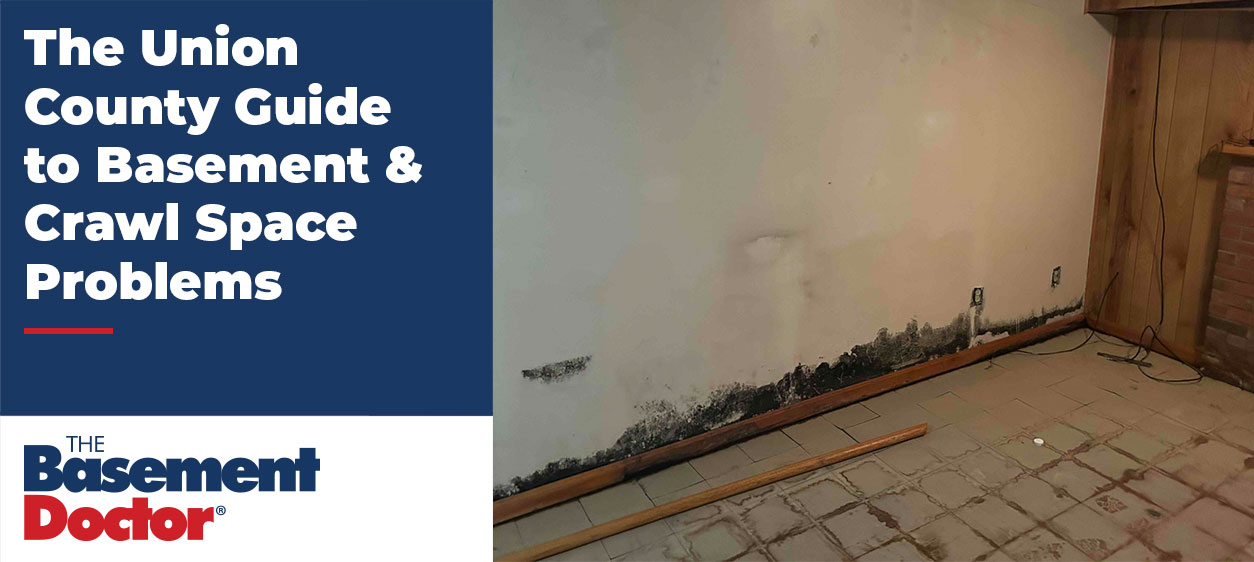
Union County’s land works against its homeowners. Flat lots and clay-heavy soils across Marysville, Richwood, and surrounding townships leave water with nowhere to go after a storm. Vented crawl spaces here regularly exceed 80 percent relative humidity during spring and summer, while properly sealed spaces stay below 60 percent. That trapped moisture is what drives wet basements, musty crawl spaces, efflorescence, and sagging floors throughout the county.
This guide covers why these problems develop, what warning signs to watch for, and the proven fixes Union County homeowners rely on — including basement waterproofing Marysville, Ohio residents trust, crawl space encapsulation, and sump pump solutions built for local conditions.
What Causes Basement and Crawl Space Problems in Union County?
Union County basement and crawl space problems rarely come from a single cause. Several forces work together, and understanding them helps explain why The Basement Doctor hears from homeowners across Marysville, Richwood, and the surrounding townships year after year.
Flat land and slow-draining soils
Much of Union County sits on flat ground with slow-draining soil. After a storm, water collects rather than running off. The Union Soil and Water Conservation District notes that drainage disputes are common here precisely because land is flat and natural watercourses move water slowly across property lines. On a flat lot, that standing water presses against your foundation far longer than it should — and that’s often the first step toward a wet basement.
New homes on former farmland
Subdivisions built on old farm fields carry a hidden problem. Field drainage tile that once moved water away from crops gets disturbed or cut during construction, and it no longer functions the way it did. Backfill around a new foundation takes years to fully settle, and grading shifts once construction equipment leaves the lot. The result? Water finds its way toward the house instead of away from it.
Older homes in Marysville and Richwood
Older foundations in Marysville and Richwood come with more joints, aging drain lines, and masonry that has had more years to wear down. Marysville’s clay-heavy soils expand when wet and contract during dry spells. That constant back-and-forth movement pushes against foundation walls until cracks and entry points form.
Homes near creeks
Properties near Mill Creek and Big Darby Creek often sit closer to a high water table, which raises the odds of water pushing through walls and floors even without a direct flood event. If your home sits in one of these lower areas, it’s worth reviewing the signs of a high water table before assuming a leak is a one-time occurrence.
Humid summers and vented crawl spaces
Dealing with a damp, musty crawl space? The culprit is often the crawl space vents themselves. Warm, humid outside air flows in and condenses the moment it contacts cooler surfaces underneath your home. Field research found vented crawl spaces averaging 80% relative humidity compared to 55% or lower in sealed ones. Exposed dirt floors make it worse, releasing 10 to 15 gallons of water vapor per day from a 1,000-square-foot footprint. Mold finds favorable conditions once humidity climbs past 60%.
Warning signs: basement efflorescence, crawl space mold, and sagging floors
Worried about your basement? Watch for water at the floor-wall joint, damp walls, white efflorescence deposits, a sump pump that runs constantly, or leaking around basement window wells.
Concerned about your crawl space? A musty smell upstairs, condensation on ducts and joists, a torn vapor barrier, standing water, sagging floors, and pests all point to the same underlying moisture problem. Up to 50% of the air on your first floor can come straight from the crawl space below, so none of these signs stay contained to one area for long.
Seeing any of these at your property? Book a free basement and crawl space inspection with our Marysville team before the damage spreads further.
How to Fix a Wet Basement
A wet basement rarely needs just one repair. It needs a sequence — starting outside and working in. Skipping a step is usually the reason the problem keeps coming back.
Outside fixes homeowners can do first
Start outside before spending anything on underground systems. Slope the soil away from your foundation at least 1 inch per foot for the first 6 to 10 feet, and extend downspouts so they discharge 5 to 10 feet from the wall. On the flat lots common across Union County, these grading corrections often resolve the issue on their own. When they don’t, basement waterproofing in Marysville picks up where the yard work leaves off.
Interior drainage and sump pumps
Water that gets past the grading needs somewhere to go. A perimeter drain channel collects seepage at the wall-floor joint and routes it to a sump pit, where a pump pushes it safely outside through a discharge line and check valve. That sump cover should sit airtight and gasketed — an open pit can allow radon and other soil gases into your living space. This is the core of interior basement waterproofing, and it depends on annual maintenance to keep the pump and float switch reliable through every storm.
Crack sealing and wall vapor barriers
A vapor barrier handles moisture vapor passing through concrete. It does not stop active seepage or relieve the pressure building up outside the wall. Drainage goes in first on any wall with active water entry — the barrier only follows once that source is under control.
Dehumidification and mold prevention
Worried about mold after the water is addressed? A dehumidifier holds relative humidity between 30 and 50 percent, which limits mold growth and eliminates musty odors. Higher-capacity units pull more than 100 pints a day with automatic drainage. On its own, though, a dehumidifier manages the symptom rather than the source. Our mold prevention approach pairs it with proper drainage so you’re solving the problem, not just masking it.
Why paint and patching don’t last
Waterproof paint typically blisters and peels within six months to two years as pressure and efflorescence build behind it. Patching compound fails the same way — the crack gets filled, but the pressure behind it hasn’t changed, so water simply finds the next weak spot. These are short-term fixes for a long-term problem. Our experts will identify what’s actually driving the water and address that directly.
How to Fix a Damp or Wet Crawl Space
A damp or musty crawl space follows its own repair sequence — but the logic is the same as a wet basement: stop the water first, then seal the space. Skipping ahead to sealing without addressing standing water is one of the most common reasons crawl space repairs fail.
Drainage for standing water
Standing water on a dirt floor needs to go somewhere before any sealing begins. An interior drain system routes seepage and surface water to a sump pump, clearing the way for the work that follows.
Vapor barrier vs. encapsulation
A vapor barrier covers exposed soil and blocks most ground moisture, but vents and air leaks stay open. Crawl space encapsulation goes further — extending the barrier up the walls and sealing every penetration. That’s the standard fix for a damp crawl space. Crawl space repair in Marysville starts with the right diagnosis; the crawl space repair itself follows once we confirm which system fits your home.
Sealing vents, rim joists, and the access door
Rigid foam board blocks each vent, sealed with spray foam, while the rim joist gets the same treatment. An insulated access door closes the last gap — because one unsealed opening undoes the rest of the work.
Dehumidification
A dehumidifier in a sealed crawl space holds humidity between 50 and 55 percent, keeping conditions below the mold threshold. The right unit size depends on your square footage, and our team makes sure the fit is right.
Supporting sagging floors
Dealing with soft or uneven floors above your crawl space? Undersized joists, a missing center beam, or sunken piers are usually the cause. Adjustable steel posts on precast pads raise the floor back to level — a lasting fix, not a patch.
Basement and crawl space problems are often connected. One free inspection checks both.
Union County Service Areas, Next Steps, and FAQs
Basement and crawl space problems don’t stop at the township line. Whether your home is in Marysville, Plain City, Richwood, or Jerome Township, the underlying causes — and the right fixes — stay consistent across Union County.
Local Considerations in Marysville, Plain City, Richwood, and Jerome Township
Marysville and Richwood carry older foundations with more years of clay soil movement working against them. Jerome Township and parts of Plain City sit on newer lots cut from former farmland, where disturbed drainage and unsettled backfill create their own set of challenges. Plain City and the Union County edge of Dublin cross the county line, yet homes there face the same clay soils that drive foundation repair in Marysville calls year after year.
What to Do Right Now: Avoid Unsafe Entry and Document Damage
Dealing with water in your basement or crawl space? Take these steps before anything else:
- Stay clear of standing water near outlets or electrical panels.
- Move belongings off the floor.
- Photograph the damage.
- Check the sump pump, gutters, and downspouts.
- Run a dehumidifier.
- Schedule an inspection.
Request a Free Basement and Crawl Space Inspection
Our team will assess your basement, crawl space, and exterior at no cost. Confirm availability, then compare written scopes before signing anything. You can count on us to give you a transparent picture of what’s going on and what it takes to fix it.
How Much Does Basement Waterproofing Cost in Marysville, Ohio?
National averages land near $5,000, with interior systems closer to $3,000 and sump pump installation running $1,200 to $2,500. Every home is different, and our free inspection gives you a clear estimate based on your specific situation.
Do I Need a Permit for Crawl Space Encapsulation in Union County?
Our team can help you understand what applies to your project.
Who Handles Basement and Crawl Space Permits in Dublin?
Dublin processes permits through its Accela Citizen Access Portal.
Ready to get started? Contact The Basement Doctor today to book your basement waterproofing in Marysville appointment today.