
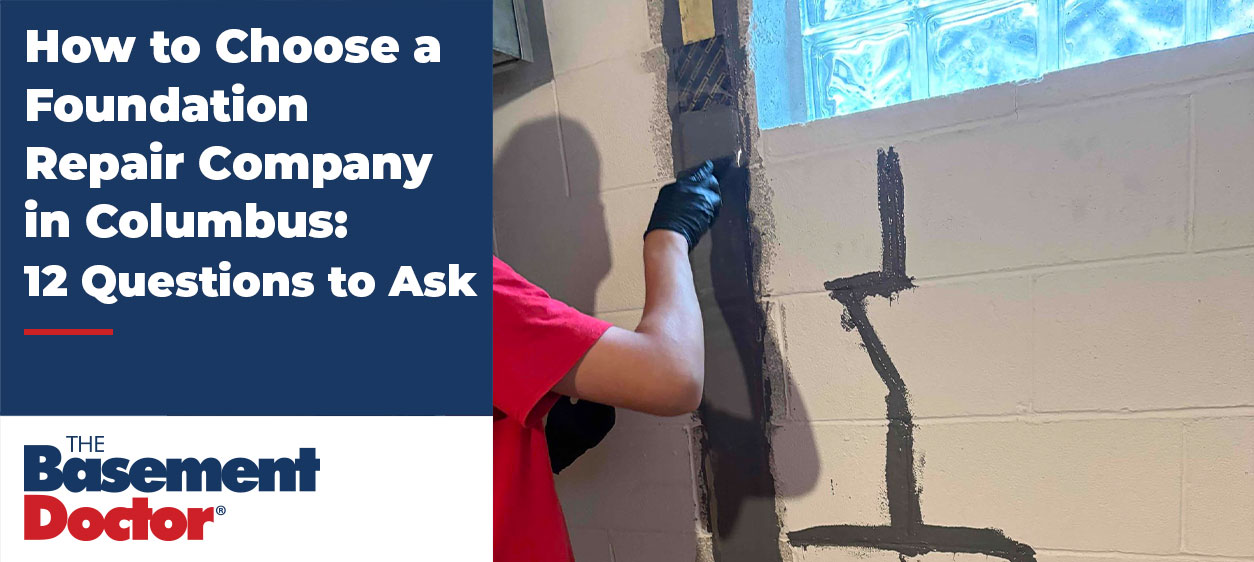
Foundation repair is expensive, permanent, and difficult to evaluate without expert knowledge. Most Columbus homeowners can spot a crack in a basement wall — but judging whether a contractor’s proposed fix will actually solve the problem is a different matter entirely.
Your home is one of your biggest investments. The foundation repair contractor you choose will determine whether that investment holds up for decades or keeps causing problems year after year.
Since 1987, The Basement Doctor has served Central Ohio homeowners, and we know what separates a reliable contractor from a risky one. We’ve put together the questions every Columbus homeowner should ask a foundation repair company before signing anything — so you can compare bids on substance, not just a sales pitch.
1. Are you licensed in Columbus and fully insured?
Start with paperwork, not a sales pitch. Before any crew touches your basement wall, you need proof that the contractor can legally operate inside city limits — and carries coverage that protects your property if something goes wrong.
Why your choice of foundation contractor matters in Columbus, Ohio
Central Ohio winters push and pull against basement block walls through repeated freeze-thaw cycles, and older neighborhoods throughout Columbus carry drainage systems built long before today’s storm patterns became common. A foundation repair contractor who misreads these local conditions can leave you with walls that keep moving — or a repair that ignores the water pressure driving the damage in the first place. For a closer look at what drives these problems locally, read our guide on common basement problems in Central Ohio.
We understand Ohio basements. That local knowledge matters when diagnosing what’s actually happening beneath your home.
Verify City of Columbus licensing requirements and current credentials
Columbus requires every contractor working inside city limits to hold the correct license before pulling a permit. A Home Improvement General Contractor license covers structural repairs to existing one, two, and three-family homes — and its scope specifically includes residential basement waterproofing. Qualifying takes a minimum of three full years of hands-on field experience, and contractors handling larger structural projects must post a $25,000 bond along with liability coverage of at least $300,000 per person and $500,000 per occurrence.
Ask the contractor for their license number. Then confirm it directly through the City of Columbus Contractor Licenses page before signing anything. A contractor who hesitates to share that number — or whose license doesn’t match the scope of work proposed — deserves a second look.
Ask for general liability and workers’ compensation insurance
A license tells you a contractor is registered. Insurance tells you who pays if something breaks.
General liability coverage handles property damage and bodily injury caused to a third party during the job, though it won’t cover the contractor’s own faulty workmanship. Workers’ compensation matters just as much — Ohio is one of only four states where construction businesses must purchase this coverage through the state fund rather than a private insurer. Request a current certificate for both policies, then call the insurer directly to confirm coverage is active before work begins.
FAQ: Does homeowners insurance cover foundation repair?
Usually not — unless a sudden, covered event caused the damage. Policies typically pay out when foundation damage results from fire, lightning, vandalism, or a vehicle crashing into the structure. What they generally won’t cover is the kind of damage most Columbus homeowners actually face: normal settling, poor drainage, tree root intrusion, or wear and tear from age. Earthquakes and floods require separate coverage entirely.
If your basement wall is bowing from soil pressure rather than a storm event, the repair bill is likely yours. That’s exactly why getting the contractor choice right from the start matters so much.
2. How long have you worked in Columbus and Central Ohio?
Years in business don’t tell the full story. Years working specifically in Columbus and Central Ohio do. Ask how long the company has operated in this region, and how many projects they’ve completed near you — whether that’s Powell, Dublin, Westerville, Hilliard, Grove City, or Gahanna.
Look for experience with local soil, drainage, and freeze-thaw conditions
Central Ohio soil is clay-heavy. It absorbs water like a sponge, swells when saturated, and shrinks when it dries out. That constant expansion and contraction pushes against foundation walls with force exceeding 5,000 pounds per square foot. Combined with more than 40 inches of average annual rainfall and freeze-thaw cycles that widen existing cracks every winter, these are conditions that punish any contractor unfamiliar with how Central Ohio ground behaves.
Older neighborhoods across the metro were built before modern drainage systems became standard — many without exterior drains or properly extended downspouts. Newer homes aren’t immune either. Grading mistakes during development can send water directly toward a foundation instead of away from it. A contractor who has worked this specific region for years will spot these patterns quickly. One who hasn’t will figure it out at your expense.
Ask about homes with your foundation type
Block basement, poured wall, or crawlspace — not every foundation fails the same way, and not every contractor has experience with all three. Ask directly whether they’ve handled your specific foundation type before.
Don’t take their word for it. Request examples. Have they stabilized bowing basement walls with steel beams or wall anchors? Repaired cracked foundation walls with carbon fiber reinforcement? Lifted settled footers using push piers or helical piles? A contractor who answers these questions with specifics — not generalities — has likely seen your exact problem before. That hands-on regional history is worth more than any sales claim.
3. Is the Inspection Free, and What Does It Include?
Worried about paying just to find out what’s wrong? A free foundation inspection is standard practice among established Columbus foundation repair companies — and that matters more than it sounds.
An independent structural engineer inspection can run anywhere from $300 to $3,000, with a typical bill around $600 and hourly rates between $100 and $200. Asking whether the inspection is free, and what it actually covers, tells you right away whether a foundation repair contractor is building trust or building a sales funnel.
What a Thorough Foundation Inspection Should Document
A qualified inspector walks both the interior and exterior of your home and documents specific findings — not just a quick glance and a quote.
The visit should cover exterior grading and drainage, since poor slope and misdirected downspouts remain the leading cause of foundation damage across Columbus. From there, a good inspector maps crack patterns: horizontal cracks point to lateral soil pressure, diagonal stair-step cracks suggest differential settlement, and vertical cracks often indicate shrinkage or movement. Bowing basement walls, active seepage, and misaligned floors or doors all belong in that report, alongside a check of your sump pit and existing drainage system.
Most Columbus inspections take one to two hours, and you should walk away with documented findings the same day. If you’re handed a quote without a written assessment, that’s worth noticing.
When an Independent Structural Engineer May Be Needed
Not every job needs a second opinion, but some do. Cracks wider than a quarter inch, active bowing, or several crack types combined with visible wall movement signal a problem serious enough to bring in an independent structural engineer. That independent report also becomes necessary for permit approval on complex repairs, insurance claims, or disputes with an adjuster — since engineers hold no financial stake in which repair gets chosen.
Not Sure What You’re Looking At?
Cracks, bowing walls, and a damp basement don’t diagnose themselves. Schedule a free foundation inspection in Columbus with The Basement Doctor, or contact us and get a documented answer before guessing at a fix.
4. What’s Causing My Foundation Problem?
A foundation repair contractor who jumps straight to a price before explaining what’s happening beneath your home hasn’t done the diagnostic work. Ask for the evidence behind the diagnosis — not just a number on a page.
Ask for Evidence That Explains the Damage
A qualified foundation repair company in Columbus should point to specific measurements, not vague language like “it’s just settling.” Ask what the cracks actually measure. Industry standards treat 1/8 inch as the point where a crack moves from cosmetic to a structural concern. FEMA’s damage assessment guide classifies horizontal cracks wider than 2 inches as major damage — though you shouldn’t wait for a crack to reach that size before asking questions.
A contractor should also check whether one side of a crack sits higher or further out than the other. That offset signals the foundation is no longer acting as a single, stable unit. To understand what causes foundation damage in Columbus beyond the crack itself, ask the contractor to walk you through grading, soil type, and drainage history before they name a fix.
Separate Settling, Wall Movement, and Water Pressure
Three separate forces usually sit behind foundation damage. A reliable contractor tells you which one applies to your house — not the same answer they give every homeowner.
Soil settling happens as clay-heavy ground compacts or shifts unevenly, often producing diagonal or stair-step cracking.
Wall movement shows up as bowing, typically in block walls where soil pressure has pushed inward over time. Saturated soil can exert thousands of pounds per square foot against a basement wall after heavy rain or a spring thaw.
Water pressure on its own can force horizontal cracks even without visible bowing, since saturated soil expands and pushes directly against the wall. Vertical cracks, by contrast, usually point to ordinary shrinkage and carry less urgency.
A contractor who proposes the same fix regardless of which force caused your damage likely hasn’t separated the causes at all.
FAQ: How Do I Know If a Foundation Crack Is Serious?
Size matters, but direction and change matter more.
A crack wider than 1/8 inch deserves a closer look. Anything approaching a quarter inch — paired with bowing or active movement — calls for prompt evaluation. Horizontal and stair-step cracks carry more weight than vertical ones because they point to outside pressure rather than simple settling.
Watch for other signals alongside the crack: doors that suddenly stick, sloping floors, or gaps opening between baseboards and walls all suggest the foundation is still moving. Mark the ends and width with a pencil, note the date, then check back in a few months. A crack that holds steady is a different problem than one that keeps spreading.
5. Which Repair Method Do You Recommend, and Why?
Knowing what’s causing the damage is only half the answer. The other half is making sure the repair method actually matches the problem — not just the contractor’s preferred system.
A foundation repair contractor who recommends the same fix for every house hasn’t taken a close enough look at yours.
Wall Anchors and Carbon Fiber for Bowing Wall Problems
Carbon fiber strips work well on bowing basement walls that have moved inward two inches or less. The strips bond directly to the wall surface with epoxy and anchor at the top with a steel angle, stopping further inward movement without any excavation.
Leaning walls with more significant bowing call for wall anchors instead. A steel plate gets buried roughly ten feet from the foundation, connected by a rod running through the wall. Tightening that rod gradually pulls the wall back toward plumb. Wall anchors do require periodic retightening, and their long-term performance depends on stable soil conditions around the buried plate.
Push Piers for Foundation Settlement Problems
Sinking and settling corners tell a different story — and call for a different fix. Push piers drive 25 to 60 feet into the ground until they reach stable soil, then hydraulic jacks transfer the home’s weight onto the piers and can lift the structure back toward its original position. Helical piers work on the same principle but screw into the ground instead, handling both lighter and heavier structures depending on soil conditions.
Stabilization or Lifting — Ask Which One Applies
These are two different goals. Stabilization stops further movement. Lifting tries to recover elevation already lost.
Recent settlement often responds well to lifting. Older, long-settled foundations may have already adjusted around their current position — and overcorrecting can cause new drywall cracks, tile damage, or plumbing stress. A contractor should tell you upfront which goal fits your situation, not just name a method.
Every System Has Limits
Carbon fiber stops working once a wall has moved past two inches. Wall anchors need adequate yard space and proper drainage around the buried plate. Piers address settlement, not bowing — they won’t straighten a wall that’s leaned inward.
A sound foundation repair proposal names the specific movement it addresses — lateral bending, vertical settlement, or both — and explains why that method fits your foundation. If the pitch sounds the same regardless of your problem, keep asking questions.
6. Will You Pull the Permits?
Permits get skipped more often than most homeowners realize. A foundation repair contractor who proposes to start structural work without one is cutting a corner that could cost you at resale, during an insurance claim, or when a home inspector flags unpermitted work years down the road.
Confirm Which Permits and Inspections Your Repair Requires
Structural foundation repairs — underpinning, helical piers, wall reinforcement — require a permit in nearly every jurisdiction because the work changes how your home is supported. Non-structural fixes like crack sealing or waterproof coatings are generally exempt.
Inside Columbus, the Department of Building and Zoning Services reviews and issues permits under Columbus City Code Title 41 and the Ohio Building and Residential Codes. Most pier, anchor, or underpinning projects also require a stamped scope of work from an Ohio-licensed professional engineer before approval. Interior crack injection or basement waterproofing that doesn’t alter the structure often skips that full plan review — though confirming directly with the city protects you from assumptions.
Homes outside city limits run permits through the suburb’s own building department or Franklin County’s Building and Zoning division. Ask which office covers your address before signing anything. Getting this wrong can delay the entire project.
Put Permit Responsibility in the Contract
Get it in writing. The agreement should clearly state that the contractor files the application, pays the permit fee, and covers the engineer’s stamped letter when one is required — not you. Many jurisdictions charge a doubled fee when work begins before a permit clears review, so confirm the schedule allows time for approval before equipment arrives on site.
Tie your final payment to permit closure and a passed inspection, not just project completion. A contractor who treats these as separate issues can leave you holding an unresolved compliance problem.
A foundation repair contractor who resists putting permits in the contract — or says “we’ll handle it informally” — is telling you something important about how the rest of the job will go.
7. What Does the Warranty Cover, and Does It Transfer?
A verbal promise about “lifetime coverage” isn’t a warranty — it’s a sales line. Before you sign with a foundation repair contractor, ask for the actual document and read it carefully.
Compare coverage for materials, labor, and future movement
A solid foundation repair warranty addresses four separate pieces: workmanship quality, material defects, the specific repair completed, and future adjustments if movement returns in that same spot. Most warranty terms fall into one of three categories — limited coverage running one to five years, extended terms spanning ten to twenty-five years, or lifetime protection. Coverage typically applies only to the work performed, not the entire foundation, so a pier installed on one wall won’t protect a crack that appears somewhere else. Know exactly what’s covered before you sign.
Read exclusions, maintenance duties, and transfer terms
Most warranties exclude earthquakes, floods, fires, and similar events outside a contractor’s control. Maintenance duties usually include keeping gutters clear, maintaining proper drainage, and avoiding major structural changes — an added room or pool built too close to the foundation can void coverage entirely. Transfer rules vary: some companies require notifying them within 30 days of a title change, and others ask for a transfer fee paid within 90 days. Thinking about selling? Review the transfer terms alongside your plans for when you sell your home, since missing a transfer deadline can leave a buyer with no protection at all.
Check the warranty claim process
Ask how a claim actually gets filed. In most cases, you contact the original contractor, provide your warranty paperwork, and describe the issue so they can schedule a follow-up inspection. If the contractor disputes coverage, you can escalate by filing a complaint with the applicable licensing board. Also ask what happens if the company closes its doors — a warranty tied to a contractor that no longer exists usually becomes worthless unless it’s backed by a separate guarantee. A company confident in its work won’t hesitate to answer any of these questions.
8. Can I Get a Written, Itemized Estimate?
Pricing confusion sends more Columbus homeowners into bad contracts than almost any other factor. Before you agree to anything, get the estimate in writing.
Separate Repair Scope, Materials, Labor, and Restoration Costs
A written estimate should name the repair scope, the materials and equipment going into the job, the labor charge, and the cost of restoring your yard or basement when the work is done. A single lump-sum number without that breakdown makes two bids nearly impossible to compare — one company’s price might already include yard restoration while another’s doesn’t. Ask each foundation repair contractor to walk you through the numbers line by line. A total figure at face value tells you very little.
Require Written Approval for Added Work
Scope changes happen. Unexpected soil conditions or additional piers can come up mid-project, and any added cost should require your written approval before work continues. Get that spelled out in the contract before anyone picks up a shovel.
FAQ: How Much Does Foundation Repair Cost in Columbus, Ohio?
Nationally, foundation repair costs typically run between $2,200 and $8,134, with averages landing around $5,000 depending on method and severity. Piering generally runs $1,000 to $3,000 per pier, carbon fiber reinforcement averages $4,000 to $12,000 for a set of strips, and full lifting can reach $20,000 to $23,000. Access difficulty, soil type, and permit fees of roughly $75 to $150 also factor into your final foundation repair cost in Columbus.
FAQ: Should I Get More Than One Foundation Repair Estimate?
Yes. Two or three estimates clarify what a fair local price actually looks like and what each company’s scope includes. Three bids from licensed contractors also help you spot a lowball offer sitting 40–50% below the rest before it costs you.
Red Flags to Watch for When Hiring a Foundation Repair Contractor
Worried you’re being pushed into a bad deal? Watch for these warning signs:
- A quote that expires if you don’t sign today
- Vague, one-line pricing with no scope detail
- Full payment demanded before work starts
- A deposit above 20–33% of the total project cost
- The same repair pitched regardless of your home’s actual problem
A contractor confident in their work won’t pressure you to decide on the spot. You can count on a reliable foundation repair company to put everything in writing and give you the time you need to make an informed decision.
9. Do You Fix Water Problems as Well as Structural Ones?
Water damage and structural damage rarely stay in separate lanes. A foundation repair contractor who only handles one side of the problem — either the crack or the moisture — isn’t giving you the full picture.
Ask how grading, gutters, and drainage affect the repair
Short downspouts and negative grading push rainwater straight back into the loose soil against your basement wall, recreating the saturated “clay bowl” that forms when a foundation hole gets backfilled. That soil then presses against the wall with enough force to bow it inward and widen existing cracks over time.
A contractor should walk your yard, check gutters, downspout length, and slope, and factor all of it into the repair plan. Fixing the wall without fixing the water source is treating half the problem. The same damage will return.
When basement waterproofing belongs in the repair plan
Damp walls, musty air, or efflorescence with no visible crack movement? Those symptoms often call for basement waterproofing on its own. Bowing walls paired with seepage, horizontal cracks that leak after rain, or wall-floor joint moisture alongside visible movement? Those need structural work layered into the solution.
Sealing a crack that keeps widening won’t stop the pressure behind it. A contractor who only offers injection without addressing the wall itself is treating a symptom, not the source. The right plan often combines wall reinforcement with a drainage system, since stabilizing the structure doesn’t automatically manage incoming groundwater.
Water and structure are usually connected. One free inspection covers both.
Concerned about whether your basement problem is a water issue, a structural one, or both? Our experts evaluate moisture and movement together in a single visit — not through whichever service happens to be on the truck that day.
The Basement Doctor’s free foundation inspection covers your crawlspace, basement walls, and exterior conditions in one documented assessment. One visit. One clear answer. No need to call two separate companies and piece together two separate opinions.
10. Can You Share Local Reviews and Completed Projects?
Ask a foundation repair company in Columbus to show you finished jobs — not just describe them over the phone. Photos and real project addresses close the gap between a sales pitch and actual proof of workmanship. A contractor confident in their results won’t hesitate to share either.
Request Comparable Projects in Columbus and Nearby Communities
Look for projects similar to yours: same foundation type, similar square footage, and comparable soil conditions. Before-and-after photos let you judge whether a bowed wall actually straightened or a settled corner actually lifted. A foundation repair contractor who dodges this request, or offers only stock photos, hasn’t built the local track record they’re claiming.
Comparable, documented project history matters more than a list of credentials. Anyone can print a certificate. Fewer contractors can show you a block basement in Westerville that stopped bowing, or a pier job in Hilliard that lifted a settled corner back to grade.
Check Reviews Across Sources and Read Complaint Responses
Don’t rely on a single source. Cross-check Google Reviews, BBB ratings, and Angi or Yelp listings to get a fuller picture. Ask friends or neighbors across Central Ohio whether they’ve used a company and were satisfied with the outcome.
Pay attention to how a company responds to a negative review or BBB complaint. One complaint rarely tells the whole story, but a pattern of unresolved issues does. When you call a reference, ask three things: did the crew finish on budget, did they communicate well, and would that homeowner hire the company again? Those three questions cut through more than any marketing claim.
FAQ: Who Is the Best Foundation Repair Company in Columbus?
There’s no single “best” answer — only a company that matches your specific situation. Judge candidates against licensing, insurance, warranty terms, inspection evidence, and verified project history. A promotional claim or an unsupported superlative with nothing behind it isn’t a reason to sign anything.
Your Checklist: Compare All 12 Questions
| Question | Contractor A | Contractor B | Contractor C |
| Licensed & insured | |||
| Years in Columbus | |||
| Free inspection | |||
| Diagnosis evidence | |||
| Repair method | |||
| Permits included | |||
| Warranty & transfer | |||
| Written estimate | |||
| Drainage addressed | |||
| Reviews verified | |||
| Timeline & protection | |||
| Financing offered |
Print this table and bring it to every estimate. See our documented project history on the testimonials and awards page alongside completed case studies before you compare bids.
11. What’s the Timeline, and How Will You Protect My Home and Yard?
A repair method chosen, a contract signed — now ask how the actual work unfolds. Who shows up each morning, how long they stay, and what your home and yard will look like once the job is done.
Confirm the Crew, Project Contact, and Daily Access Needs
Get one name. A single project contact keeps communication clear and prevents the frustration of repeating yourself to whichever crew member happens to be nearby. For interior repairs, anything within ten feet of the work area needs to be cleared — furniture, stored items, and sometimes trim or drywall. Outdoor work requires moving landscaping, decor, and vehicles off the driveway so the crew has the room they need to work safely and efficiently.
Document Protection for Utilities, Landscaping, and Indoor Spaces
A careful, professional crew covers furniture and valuables with plastic sheeting, lays tarps along high-traffic paths, and may temporarily shut off your heating or cooling system to keep dust from spreading through the house. Our team respects your home and keeps the worksite clean throughout the process. Get this protection confirmed in writing, since not every foundation repair contractor follows the same standard.
Clarify Cleanup, Restoration, and Final Inspection
Ask what the finished job actually looks like. Excavated soil should be backfilled and compacted, removed concrete replaced, and all debris cleared from the site before the crew leaves. Request a final walkthrough — and keep a direct line open through our customer care team if questions come up afterward.
FAQ: How Long Does Foundation Repair Take?
Most repairs finish within two to three days. Simple crack sealing can wrap up in a single day, while complex pier work may stretch past a week. Pier jobs scale with the scope: three to five piers often finish in a day, while thirteen or more typically take two to three days. Your project contact should give you a realistic timeline upfront — not a rushed estimate designed to get the contract signed.
12. Do You Offer Financing and Ongoing Maintenance?
Financing deserves the same careful attention as the repair method itself. A payment plan with the wrong terms can cost more over time than the foundation work it’s funding.
Compare Interest Rates, Fees, and Total Financing Costs
Personal loans typically fund within one to three days and carry APRs between 7.99% and 24%. HELOCs offer lower rates — around 8% to 10% — but take two to six weeks to process. Contractor financing through partners can range from 0% promotional offers to 29% APR, and “same-as-cash” plans often charge retroactive interest above 26% if the balance isn’t cleared within the promotional window.
Ask any foundation repair contractor for the total cost over the full loan term, not just the monthly payment. A low monthly figure can still hide a high rate.
Tie Payments to Clear Project Milestones
A fair payment agreement links each installment to a completed phase: a deposit at signing, a payment after piers or anchors are installed, and a final payment at walkthrough. Full payment upfront before work begins is a red flag — a contractor confident in their work won’t ask for it.
Ask About Ongoing Maintenance and Follow-Up Inspections
A reliable foundation repair company doesn’t disappear once the job wraps up. Ask whether the company offers a follow-up inspection plan to monitor drainage and wall stability over time. Long-term protection matters as much as the initial fix.
Our commitment doesn’t end when the crew leaves. The Basement Doctor backs every project with ongoing support, so you can count on us well after installation day.
Ready to Get Started? Schedule a Free Foundation Inspection in Columbus
Concerned about your foundation? Don’t wait for a small crack to become a bigger problem. Contact us today for a free foundation inspection and a written, itemized quote from a trusted Columbus foundation repair team.
Conclusion
The right foundation repair company in Columbus proves its value with evidence, not promises. Licensing, honest diagnosis, written warranties, and itemized pricing all point toward a contractor who respects your home and stands behind the work.
Foundation repair is permanent. Getting it right the first time matters far more than getting it done fast.
The Basement Doctor has served Central Ohio homeowners since 1987, and we’re ready to help you get a documented answer — not a sales pitch. Schedule a free Columbus foundation repair inspection and contact us today. Our experts will take care of it.